Ahilyabai Holkar: The Indian Model of Women’s Leadership, Civilizational Responsibility, and Social Empowerment
Total Views |


-Kailash Chandra
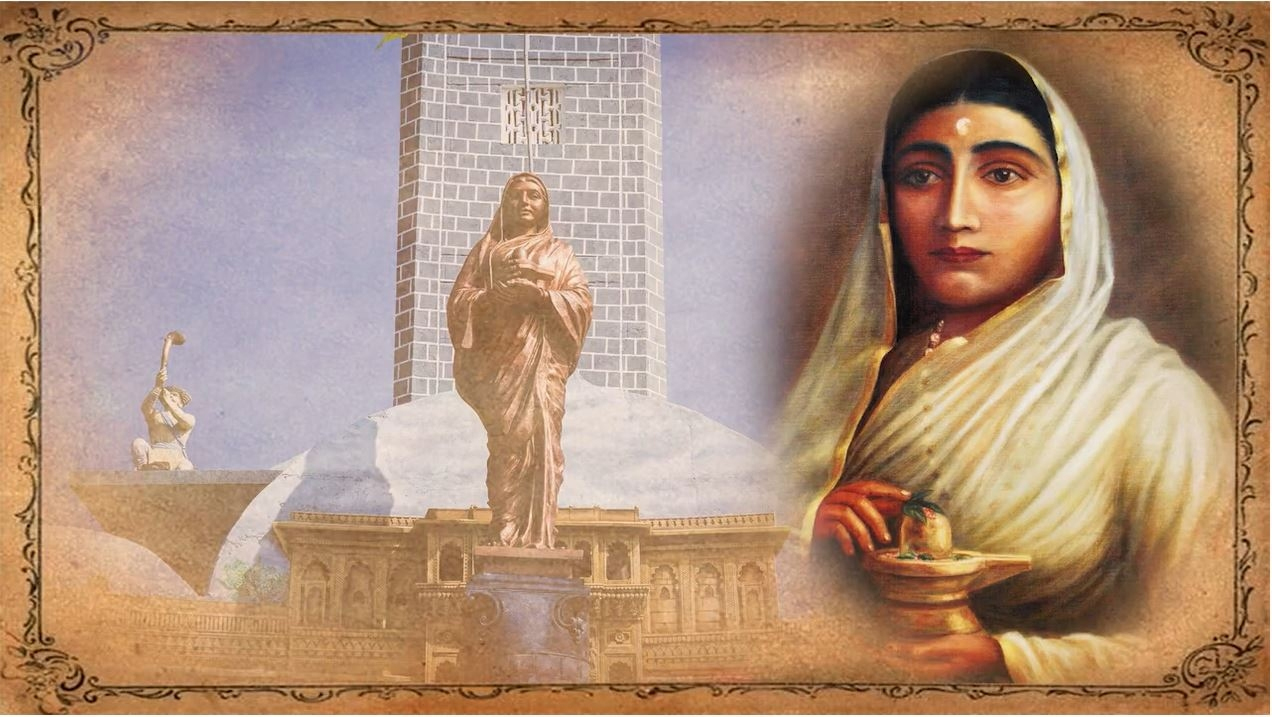
As contemporary societies continue to debate women's empowerment, gender equality, and leadership, history offers remarkable examples of women who transcended the limitations of their age and redefined public life through wisdom, courage, and service. Among such personalities, Punyashlok Devi Ahilyabai Holkar stands as one of the most extraordinary figures in Indian civilization.
Remembered not merely as a queen but as a nation-builder, cultural restorer, social reformer, and compassionate administrator, Ahilyabai Holkar represents a uniquely Indian model of women's empowerment—one rooted not in confrontation, but in responsibility; not in privilege, but in service; and not in power alone, but in moral authority.
Born on May 31, 1725, in the village of Chondi in present-day Maharashtra, Ahilyabai came from a modest family. Her father, Mankoji Shinde, served as a village Patil. Unlike many rulers born into royal privilege, her rise to prominence emerged through personal merit, resilience, and character.
Married to Khanderao Holkar, the son of Malhar Rao Holkar, founder of the Holkar State in Malwa, Ahilyabai entered public life through one of the most influential Maratha families of the eighteenth century. Yet her life was marked by repeated personal tragedies. She lost her husband in battle in 1754. Later, her father-in-law and mentor Malhar Rao Holkar passed away. Soon afterward, she also lost her only son, Male Rao.
For most individuals, such a succession of personal losses would have resulted in withdrawal from public life. Ahilyabai, however, transformed grief into strength. Rising above personal sorrow, she assumed the responsibility of governing Malwa and emerged as one of the most respected rulers in Indian history.
Her life presents an important lesson for contemporary discussions on women’s empowerment. Empowerment is often understood merely as access to rights, representation, or opportunities. While these are important, Ahilyabai’s life demonstrates a deeper dimension of empowerment—the capacity to shoulder responsibility, make difficult decisions, and contribute meaningfully to society even under adverse circumstances.
From 1767 until her death in 1795, Ahilyabai governed Malwa with exceptional wisdom and integrity. Her administration became synonymous with justice, efficiency, prosperity, and public welfare. British historian Sir John Malcolm observed that her objective was to improve the condition of her state through justice and benevolence, ensuring the welfare and happiness of her people.
Perhaps her most enduring contribution lies in the preservation and revival of India’s civilizational heritage. The eighteenth century was a period during which many sacred sites across India had suffered neglect, destruction, or decline due to centuries of political upheaval and invasions. Ahilyabai recognized that temples were not merely places of worship; they were centers of social life, cultural continuity, education, and collective memory.
Acting on this vision, she sponsored the reconstruction, restoration, or development of numerous temples, ghats, dharamshalas, wells, reservoirs, and pilgrim facilities across the subcontinent.
Among her most celebrated achievements was the reconstruction of the Kashi Vishwanath Temple in Varanasi, which remains one of Hinduism’s most sacred shrines. She also contributed significantly to the restoration of the Somnath Temple in Gujarat, a symbol of India's enduring civilizational resilience. Her patronage extended to Ayodhya, Haridwar, Gaya, Badrinath, Kedarnath, Gangotri, Omkareshwar, Ujjain, Nashik, Jagannath Puri, Pushkar, Nathdwara, and numerous other pilgrimage centers.
What makes these contributions remarkable is their geographical spread. At a time when transportation and communication were limited, Ahilyabai viewed India not as a collection of disconnected regions but as a civilizational whole. Through her support of pilgrimage routes, temples, public utilities, and religious institutions, she strengthened cultural unity and national consciousness long before the emergence of modern political nationalism.
Her vision of governance was deeply influenced by spiritual values. A devoted worshipper of Lord Shiva, she famously inscribed “Shri Shankar Aagya” (By the command of Lord Shankar) on royal orders. Yet her spirituality was never exclusionary. For Ahilyabai, faith was inseparable from public service.
She established feeding centers for pilgrims, built roads and water facilities, supported scholars, and ensured that places of worship functioned as centers of community welfare. Her governance reflected a profound belief that political authority is a sacred trust rather than a personal possession.
This philosophy offers an important perspective in contemporary public discourse. Leadership, according to Ahilyabai’s example, derives legitimacy not from dominance but from service. Authority exists to uplift society rather than to serve individual interests.
Ahilyabai’s contribution to women's rights was equally significant. Long before modern debates on gender justice, she introduced reforms that enhanced the dignity and security of women. One notable example concerned inheritance laws affecting widows. Under prevailing customs, if a widow had no son, her deceased husband's property could be absorbed into the state treasury.
Recognizing the injustice of this practice, Ahilyabai altered the policy and granted widows rights over their husbands’ property. This reform represented a significant step toward women's economic security and social dignity.
Importantly, her approach to women's empowerment did not emerge from ideological conflict between men and women. Instead, it arose from a commitment to justice and human dignity. This reflects a distinctive Indian understanding of gender relations—one based on complementarity, cooperation, and mutual respect rather than adversarial competition.
Another remarkable aspect of Ahilyabai’s leadership was her compassion. Historical accounts repeatedly describe her concern for the poor, the vulnerable, and the marginalized. She established charitable institutions, distributed food during times of hardship, and ensured support for pilgrims and travelers.
Her compassion extended beyond human beings. She arranged feeding provisions for animals and birds, protected grazing lands, and supported cattle welfare. Such measures reflected a holistic worldview in which human prosperity was linked to harmony with nature and other living beings.
Economically, Ahilyabai demonstrated notable foresight. She promoted local industries and encouraged productive livelihoods. The textile tradition of Maheshwar, especially the renowned Maheshwari saree industry, flourished under her patronage and continues to support artisans even today. Her economic policies reveal an early understanding of sustainable local development and community-based prosperity.
Her diplomatic and administrative abilities were equally impressive. Historical records indicate that she successfully navigated political challenges through wisdom and strategic judgment rather than unnecessary warfare. She maintained peaceful relations with neighboring states while safeguarding the interests of her kingdom.
This combination of firmness and compassion made her one of the most admired rulers of her era. Even contemporary rulers and foreign observers acknowledged her exceptional qualities. The Nizam of Hyderabad reportedly remarked that no ruler of the time could equal her. Scholars, poets, and social thinkers across generations have continued to celebrate her legacy.
In modern discussions of women's leadership, Ahilyabai Holkar remains profoundly relevant. She demonstrates that leadership is not defined by gender but by character. She illustrates that true empowerment combines strength with empathy, authority with accountability, and ambition with service.
At a time when societies worldwide are searching for models of ethical governance, social harmony, and inclusive development, Ahilyabai’s life offers valuable lessons. She showed that a leader can be deeply rooted in cultural traditions while remaining progressive in social reform. She proved that spiritual conviction and public welfare can reinforce one another. Most importantly, she demonstrated that the highest purpose of power is the welfare of society.
More than two centuries after her passing in 1795, Ahilyabai Holkar continues to inspire millions. She was not merely the ruler of Malwa; she was a custodian of India’s civilizational heritage, a pioneer of social justice, and an enduring symbol of women’s leadership.
Her legacy reminds us that the true measure of greatness lies not in the authority one holds, but in the lives one transforms. In that respect, Ahilyabai Holkar remains one of the most luminous figures in the history of India and a timeless model of empowered leadership for the world.